How I Changed My Life in Three Months After Years of Feeling Stuck
Three months can sound like one of those suspiciously quick internet promises.
Change your life in 90 days. Wake up at 5am. Drink something green. Become an entirely different person before breakfast.
That is not what happened here.
I did not become richer, eliminate every problem or suddenly gain complete control of my life. I still have debt. My income is not as secure as I would like. Hard things still happen.
But within three months, I moved my family from Manchester to Dorset, changed my working life and began building The Freedom Game properly.
My life is not perfect. But it is closer to perfect than I have ever got before and for the first time ever my life actually feels like it is mine.
That difference is enormous.
I had built a sensible life that I did not actually want
On paper, plenty of what we had was sensible.
We owned a home. We were on the property ladder. We had jobs. The children had childcare. We lived near the things we knew.
In reality, I could spend up to an hour and a half doing a journey that should have taken fourteen minutes (woo rush "hour"). The children were in childcare for long days. Our house was damp, cramped and never felt like the place in which I wanted to spend the next chapter of my life.
I was exhausted. I was missing time with my children. My nervous system seemed permanently braced for the next commute, bill, siren or logistical problem.
The most uncomfortable part was that nobody had trapped me there.
I had simply collected enough reasonable explanations for staying that I had stopped asking whether I wanted the life they were protecting.
The property ladder had become a rule instead of a tool
For years, one of my biggest goals had been to own a home outright.
That goal made sense to me. Owning a home represented security, lower costs and freedom from a mortgage.
But eventually I had to ask a more precise question:
Did I want to own this home?
The answer was no.
I wanted what owning a home symbolised. I did not want to spend my life in that particular house, in that particular place, merely because selling felt like moving backwards.
That distinction changed everything.
Within a week, the house was on the market. Within three months, we had moved.
It looked reckless if you judged the decision by one conventional measure. It felt obvious when I judged it by the life I actually wanted to live.
Sometimes staying becomes comfortable enough to postpone leaving
My working situation had changed too.
The flexible arrangements that had made the job possible shifted. Coaching disappeared from my role. Childcare was becoming unaffordable. Credit cards were covering bills.
It was not comfortable. But it was comfortable enough to keep postponing the decision.
That is a dangerous kind of stuckness. Nothing is catastrophic enough to force a move today, so you tolerate it for another week, another month and sometimes another five years.
The pain of remaining the same eventually became greater than my fear of changing.
When I started telling people what I actually wanted, I found a work opportunity that suited my life far better. I did not have a complete ten-year plan. I made the next honest move.
I answered the fear, then asked a better question
Big changes generate an impressive list of disasters in your head.
What if we regret selling? What if the move is a mistake? What if the new job does not work? What if The Freedom Game fails? What if I make everything harder?
Those questions deserve answers. I did not ignore risk or pretend optimism would pay the bills.
I looked at the practical fears and worked out what we would do if each one happened.
Then I asked the question I had barely allowed myself to consider:
What if it works out?
What if the children have more space? What if we sleep better? What if being near family matters even more than we expect? What if I build work around the life I want instead of forcing life into the gaps left by work?
Fear had been allowed to present its evidence as certainty. Possibility had barely been called as a witness.
The familiar option is not automatically the safer one
Behavioural researchers call part of this pull status quo bias. We tend to favour the current state simply because it is already ours, even when alternatives may serve us better.
The familiar problem feels measurable. A different future contains unknowns. So we mistake familiarity for safety.
But staying is a decision too. It has costs, risks and consequences.
I had delayed The Freedom Game partly because I was frightened of doing it half-heartedly and proving it could fail. Yet not trying guaranteed the outcome I feared. It could not work while I refused to give it a genuine chance.
Once I saw that, the old decision stopped looking neutral.
The life around the decision matters
After we moved, ordinary things changed.
The school run became manageable. I lived nearer my mum. The children had room. The noise in my head and around my life became quieter. I slept better.
Research cannot decide where anyone should live, but it does support something many of us feel instinctively: strong social support can buffer the impact of stress, and environmental noise can affect sleep and health. The classic stress-buffering research and the World Health Organization's guidance on environmental noise helped me understand why these apparently ordinary details could matter so much.
Then my dad died unexpectedly.
Nothing makes that okay. But because we had moved, I could be present. My children had seventeen days living close to their grandad that they would not otherwise have had.
You cannot optimise life against every future loss. You do not know what is coming.
You can decide whether the life you are building leaves room for the people and moments that matter now.
Freedom is not the absence of problems
I used to imagine freedom as a distant finish line.
No debt. Enough money. Total security. Complete control. Then, finally, permission to live.
That definition kept pushing life into the future.
Freedom, for me, is not having no problems. It is not being rich or arranging the world so nothing painful can happen.
It is creating a life that feels like yours.
It means treating your present self as someone worth considering, not merely the person who must sacrifice everything for a hypothetical future version of you.
Sometimes the conventional decision is the right one. Sometimes keeping the mortgage, staying in the job or delaying a move is genuinely necessary.
The point is not to blow up your life.
The point is to notice whether a practical constraint is truly a constraint, or whether it is an old rule you have stopped examining.
Four questions for the life you keep saying you want
If you feel stuck, you do not need to solve the next decade tonight.
Start here.
### 1. What do you actually want?
Not what sounds sensible. Not what proves you are successful. Not what would satisfy somebody else's idea of a good life.
What do you want your ordinary Tuesday to feel like?
### 2. What is the “but”?
I want to move, but we own this house.
I want different work, but leaving is risky.
I want to build the thing, but what if it fails?
Write the “but” down. Vagueness makes it powerful.
### 3. Is it an obstacle, or an old rule?
Some obstacles are real and need a plan. Money, caring responsibilities, contracts and health cannot be wished away.
Other barriers are inherited rules: property ownership always means progress; changing direction means failure; sensible people stay; you must know the whole route before taking one step.
Do not treat those two categories as if they are the same.
### 4. What is the next move?
Not the complete transformation. The next move.
Have the conversation. Calculate the real number. Tell somebody what you are looking for. View the place. Put the date in the calendar. Make the call.
Clarity often arrives after movement, not before it.
Three months did not fix everything
It did something more valuable.
It showed me that years of feeling stuck were not proof that I could not change. They were evidence that I had been protecting a set of decisions I no longer wanted.
I still have uncertainty. I also have more time with my family, more connection, more space and work that fits the life I am trying to build.
From the outside, some of my choices may look like steps backwards.
From inside my actual life, they feel like progress.
If you are considering a change, tell me this: what is the “but” that keeps appearing after the thing you say you want?
Watch the full video
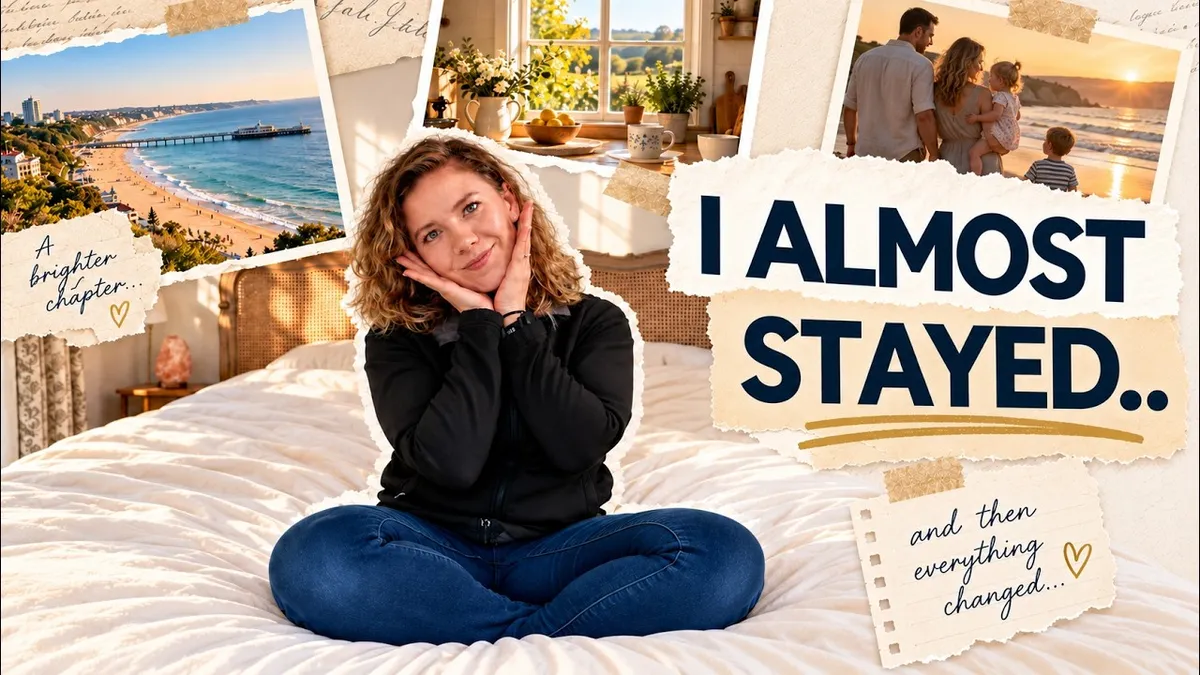
How I Changed My Life in 3 Months After Years of Feeling Stuck